








Imagine an orchestra performing a complex piece of music. The strength of the performance depends on many instruments working together—each contributing something different while staying in sync. The conductor plays an essential role, helping musicians stay coordinated, adjusting to changes in tempo, and ensuring the parts blend into a unified whole.
Reading works much the same way. To make meaning from text, readers must decode unfamiliar words, hold ideas in mind, monitor for coherence, and adapt when comprehension breaks down. Executive function (EF) serves as the conductor, guiding attention, memory, and strategy use so that the components of reading—word recognition, language comprehension, and higher-level reasoning—work together as an integrated system.
Research shows that these executive skills are central to literacy development, supporting both the acquisition of foundational reading abilities and the comprehension of complex texts (Butterfuss & Kendeou, 2017; Cirino et al., 2019).
Reading Is an Active Process
The Active View of Reading (Duke & Cartwright, 2021) builds on the foundational principles of the Simple View of Reading to capture this fuller picture. In this model, comprehension is not simply the product of decoding plus language knowledge. It is a dynamic, self-regulated process in which executive functions—including attention, working memory, and cognitive flexibility—are continuously engaged. Reading, through this lens, is something a reader actively manages in real time, not something that happens to them.
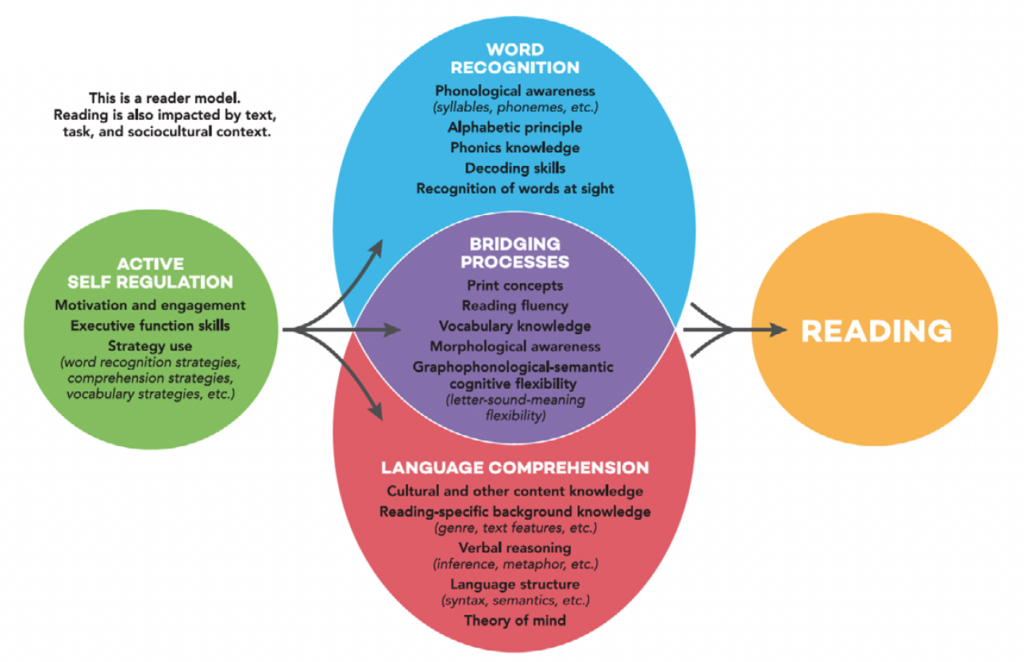
(Duke & Cartwright, 2021.)
This matters for how we understand reading difficulty. Even students with solid word recognition and vocabulary may struggle to follow the thread of a passage or arrive at a main idea if their executive skills are not supporting the process (Butterfuss & Kendeou, 2017; Cutting et al., 2009).
What EF Does During Reading
Executive function is not one thing—it is a set of interrelated cognitive skills that work together. Three are especially important to reading:
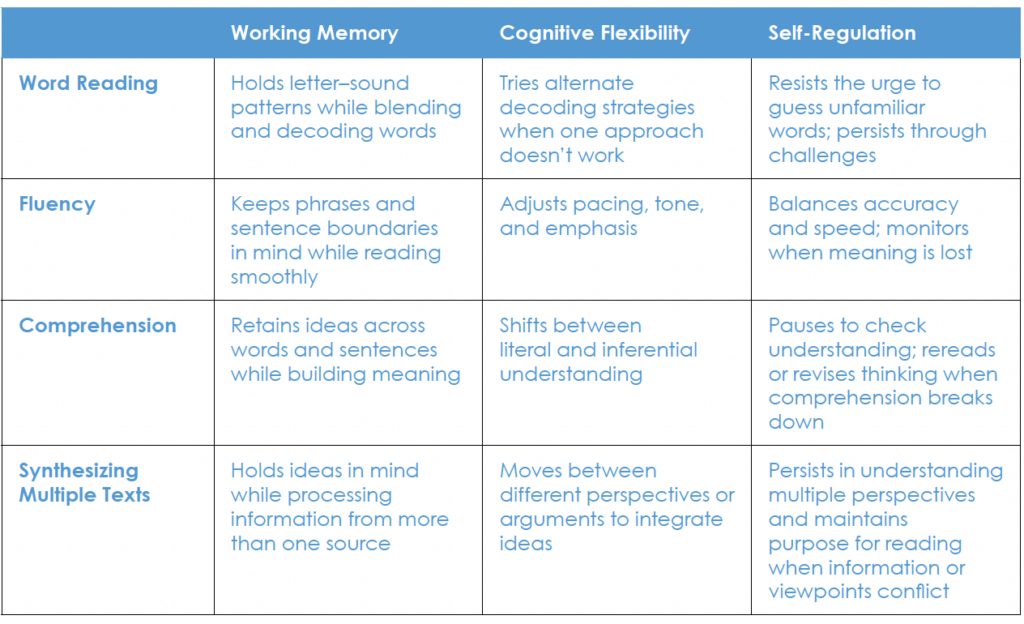
- Working memory holds information in mind while processing new input—for example, keeping track of earlier details while reading a complex sentence, or retaining the sequence of sounds while blending a word.
- Cognitive flexibility allows readers to shift strategies when one approach isn’t working—trying a different way to decode an unfamiliar word, or moving between literal and inferential understanding of a text.
- Inhibitory control (self-regulation) helps readers resist the impulse to guess, stay focused despite distraction, and pause to verify understanding before moving on.
At early stages of reading development, these processes support decoding and word recognition. As texts become more demanding, they become essential for maintaining coherence, generating inferences, and synthesizing information across sources. Reading is a goal-directed activity at every level, and executive function is what keeps it on track (Burgess & Cutting, 2023; Sesma et al., 2009).
Neurobiological evidence reinforces this point. The brain systems that support executive function are also engaged during reading, meaning that literacy draws on both the neural pathways that process written language and those that govern attention, planning, and working memory. When these systems do not coordinate efficiently, readers may struggle even when their foundational skills are otherwise adequate (Burgess & Cutting, 2023; Cutting et al., 2009).
Sample EF Processes Across Reading Demands
What the Research Tells Us About Instruction
One of the most important—and often misunderstood—findings in this area is that general executive function training does not reliably improve reading. Playing memory games or practicing inhibition exercises in isolation does not transfer to reading comprehension. What works is embedding executive function practice within authentic reading tasks, where these skills can be activated in the context of meaning-making (Cartwright & Palian, 2024).
In a large meta-analysis, Cartwright and Palian (2024) found that interventions targeting reading-specific executive functions produced significantly greater gains in comprehension than general EF training. When students practiced coordinating attention between main ideas and supporting details, holding and updating information across a text, and monitoring their own understanding as they read, comprehension improved measurably.
Classroom research by Ruffini and colleagues (2025) showed what this looks like in practice. Rather than treating executive function as a separate curriculum, teachers embedded EF-focused activities directly into comprehension instruction. Students sequenced sentences to maintain text coherence, identified inconsistencies in passages, connected new information to prior knowledge, and shifted flexibly across sections of a text—all while receiving real-time feedback and opportunities for self-assessment. The result was simultaneous, measurable growth in both executive skills and reading comprehension.
Strategies for the Classroom
The research points to a clear instructional principle: The most effective way to strengthen executive function in readers is to make the thinking behind reading visible and teachable. The following strategies reflect that principle.
Before Reading
- Set a clear purpose for reading and preview the text. This activates relevant background knowledge and focuses attention before students encounter the material. Students who enter a text with a goal in mind are better positioned to monitor whether they are meeting it.
During Reading
- Use graphic organizers and structured note-taking templates to reduce working memory load. Giving students a concrete way to capture and organize key information as they read frees up cognitive resources for meaning-making.
- Teach students to monitor comprehension actively—to pause when something doesn’t make sense and apply a fix-up strategy (rereading, looking for context clues, breaking a word into parts) rather than pressing on.
- Prompt cognitive flexibility explicitly. When students encounter an unfamiliar word or a confusing passage, guide them through the process of trying an alternative approach rather than defaulting to guessing or avoidance.
After Reading
- Build in structured opportunities for students to reflect on the strategies they used and which ones helped. This kind of metacognitive awareness—knowing how you read, not just what you read—strengthens the ability to plan, monitor, and adapt over time (Duke & Cartwright, 2021).
- Use text-based prompts that require students to locate evidence, consider multiple perspectives, or reconcile conflicting information. These tasks directly engage working memory, cognitive flexibility, and self-regulation in service of comprehension.
Reading depends on the integration of multiple systems: word recognition, language comprehension, and executive function. These elements work in concert. When any one is underdeveloped or unsupported, the whole performance suffers.
For students with language-based learning disabilities, the executive demands of reading are often compounding challenges—layered on top of the work required to decode and access language. Understanding how executive function operates within reading, and designing instruction that targets these processes in context, is essential to helping every student become a purposeful, self-directed reader.
When teachers make thinking visible, they give students more than comprehension strategies. They teach students how reading works—and how to manage it for themselves.
References
Burgess, A. N., & Cutting, L. E. (2023). The behavioral and neurobiological relationships between executive function and reading: A review and preliminary findings. Mind, Brain, and Education, 17(4), 267–278. https://doi.org/10.1111/mbe.12378
Butterfuss, R., & Kendeou, P. (2017). The role of executive functions in reading comprehension. Educational Psychology Review. https://doi.org/10.1007/s10648-017-9422-6
Cartwright, K. B., & Palian, S. R. (2024). Considering roles of executive functions in the science of reading: A meta-analysis highlighting promises and challenges of reading-specific executive functions. Educational Psychologist, 1–28. https://doi.org/10.1080/00461520.2024.2418392
Cirino, P. T., et al. (2019). Executive function: Association with multiple reading skills. Reading and Writing, 32(7), 1819–1846. https://doi.org/10.1007/s11145-018-9923-9
Cutting, L. E., Materek, A., Cole, C. A. S., Levine, T. M., & Mahone, E. M. (2009). Effects of fluency, oral language, and executive function on reading comprehension performance. Annals of Dyslexia, 59(1), 34–54. https://doi.org/10.1007/s11881-009-0022-0
Duke, N. K., & Cartwright, K. B. (2021). The science of reading progresses: Communicating advances beyond the simple view of reading. Reading Research Quarterly, 56(S1), S25–S44. https://doi.org/10.1002/rrq.411
Ruffini, C., Pizzigallo, E., Pecini, C., Bertolo, L., & Carretti, B. (2025). Integrating executive function activities into a computerized cognitive training to enhance reading comprehension in primary students. Reading Research Quarterly, 60, 1–22. https://doi.org/10.1002/rrq.70006
Sesma, H. W., Mahone, E. M., Levine, T., Eason, S. H., & Cutting, L. E. (2009). The contribution of executive skills to reading comprehension. Child Neuropsychology, 15(3), 232–246. https://doi.org/10.1080/09297040802220029