




Summer Program Morning Academic Course Offerings
Grade 3
Listening Comprehension and Expository Writing Skills
By utilizing engaging children’s read alouds and exciting current event selections, instruction will include strategies for comprehension and vocabulary development. The course will also focus on using sentence strategies to enhance understanding of the text.
Skills may include:
- building background knowledge
- identifying story elements and text structures
- summarizing
- vocabulary development
- use of conjunctions, sentence combining, and sentence expansion
Math Mania
This course is designed to reinforce skills learned in second grade and provide a foundation for skills that will be covered in third grade. A hands-on, multisensory approach will be used to teach math skills and strategies. Mathematical games, manipulatives, and technology will be used to reinforce concepts and provide opportunities for independent practice. These techniques, along with group work, will help students gain a sense of confidence and enthusiasm for the subject.
Topics may include:
- place value
- addition, subtraction, multiplication, and division
- computational strategies to improve speed and accuracy
- problem solving
Grades 4-5
Book Club
Students in this course will read and discuss several high-interest books with an emphasis on comprehension skills. Readings will include various genres ranging from fiction to non-fiction. Instruction in vocabulary development will be included throughout the course. Students may also use writing strategies to enhance comprehension.
Skills may include:
- making predictions, inferring, paraphrasing, and summarizing
- identifying main ideas and supporting details
- examining figurative language
- building accuracy and fluency
Math Made Fun
This course is designed to help students enhance their math skills using real-life scenarios to show the relevance of math in our world. Emphasis will be on creative problem solving within the context of high-interest topics to which students can relate, such as sports, fashion, and music. Both mathematical games and interactive software will be used to reinforce concepts and to provide opportunities for individual practice and group work.
Topics may include:
- whole number concepts and operations
- number sense, estimation, and rounding
- measurement
- integers
- data and graphing
- problem solving
Getting Organized in Writing
This class will focus on improving writing skills that will aid students in achieving academic success. Student writing in this course will focus on composing sentences using varied language structure and precise vocabulary.
Skills may include:
- brainstorming and categorizing
- sentence-level skills: sentence and fragment identification, sentence expansion, and revising and editing
- paragraph-level skills: utilizing outlines to create compositions, creating topic and concluding sentences, revising and editing for cohesiveness
Forensic Science Crime Laboratory
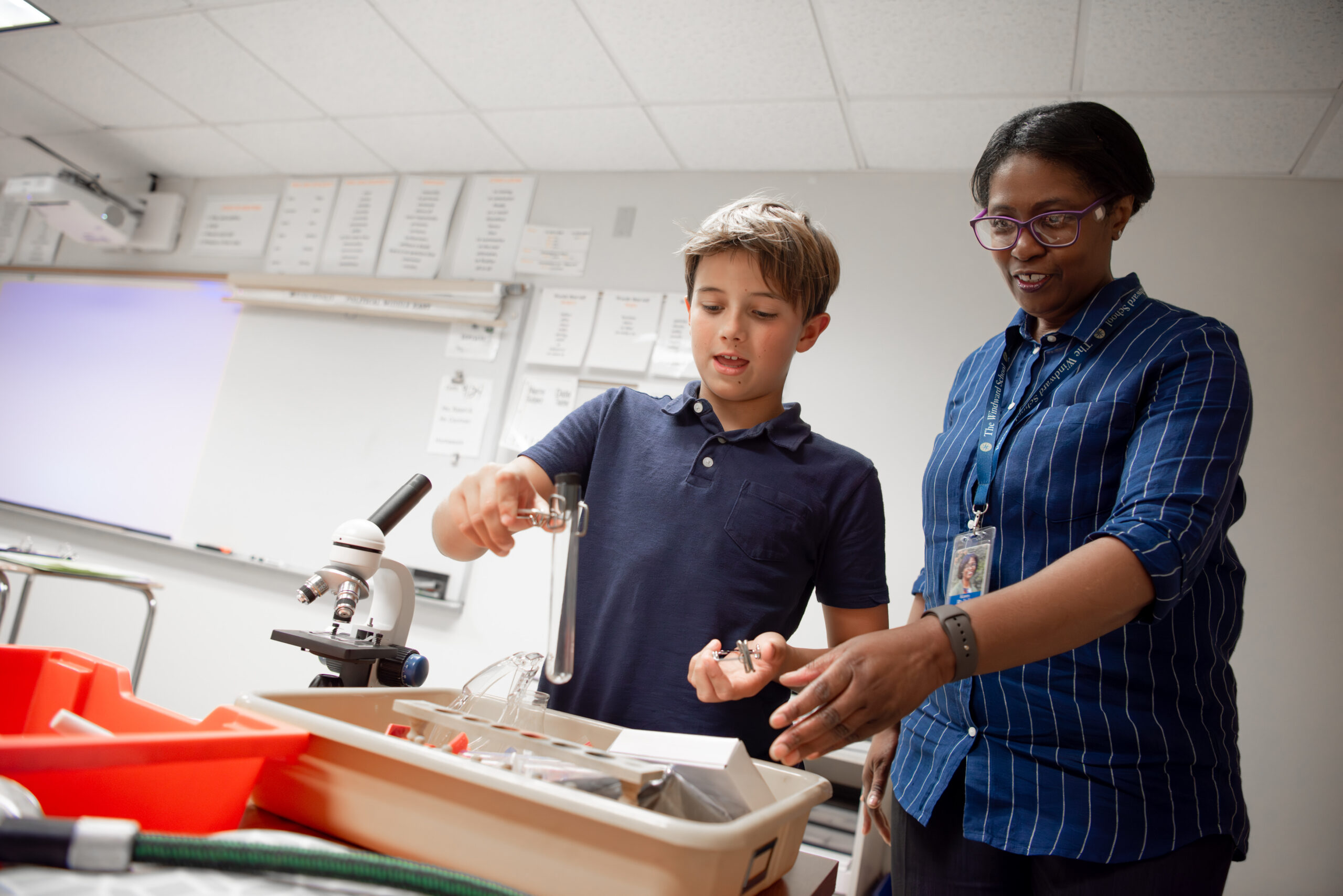
Students who join the Windward Junior Investigator Team will work in a classroom laboratory, learning and utilizing difference forensic science techniques to analyze crime scene evidence. In addition, students will use The Windward School’s reading and writing programs throughout investigations to clarify their analysis and communicate their findings.
Skills may include:
- interpreting and following multi-step lab procedures
- recording observations
- analyzing data and drawing conclusions
- learning laboratory procedures
- developing inferential and deductive reasoning
Grades 6-7
Math Methods
Using multisensory techniques, this course will allow students the opportunity to gain extra practice in topics newly introduced during the sixth and seventh grades, from basic arithmetic up to and including pre-algebra topics. Additionally, classroom activities will focus on interactive learning, enabling students to explore, practice, and internalize strategies.
Topics may include:
- integer operations
- algebraic expressions
- fractions, decimals, percentages, and ratios
- graphing on the coordinate plane
- word problems using model drawing
Writing Skills for Academic Success
Using high-interest current events and expository topics, students will be introduced to organizational techniques that can help them succeed in their writing assignments. Throughout the course, students will transition from creating complex sentences to utilizing outlines to draft compositions.
Skills may include:
- brainstorming and categorizing
- annotating
- sentence-level skills: grammar and syntax, incorporating precise vocabulary, creating complex and varied sentences
- composition-level skills: utilizing outlines to create single paragraphs and essays, developing introduction and conclusion paragraphs, crafting effective thesis statements, and revising and editing techniques
A Novel Idea
This course is designed to improve students’ reading comprehension skills through poetry, short stories, and fictional trade books. Comprehension will be supported by the organization of information using Windward’s Expository Writing Skills program in order to draft written responses and paragraphs.
Skills may include:
- summarizing, inferring, and predicting
- identifying main ideas and relevant details
- analyzing literary devices such as characterization, symbolism, and theme
- interpreting figurative language
Forensic Science Crime Laboratory (grade 6)
Students who join the Windward Junior Investigator Team will work in a classroom laboratory, learning and utilizing difference forensic science techniques to analyze crime scene evidence. In addition, students will use The Windward School’s reading and writing programs throughout investigations to clarify their analysis and communicate their findings.
Skills may include:
- interpreting and following multi-step lab procedures
- recording observations
- analyzing data and drawing conclusions
- learning laboratory procedures
- developing inferential and deductive reasoning
Grades 8-9
Writing for the Upper Grades
Utilizing a multisensory approach, this course is designed to provide students with specific strategies that will allow them to express themselves clearly and precisely in written form. Students will receive instruction in utilizing outlines to craft several descriptive, problem-solution, and argumentative essays on a variety of high-interest expository topics.
Skills may include:
- summarizing and paraphrasing information
- annotating and outlining
- composing complex sentences and paragraphs
- using proper sentence starters and subordinating conjunctions
- crafting thesis statements
- developing introductions and conclusions
- revising and editing strategies
Exploring Literature
This course teaches students to decode literature by analyzing theme, symbolism, and literary devices. Rich, guided classroom discussions will culminate in writing activities that explicitly teach mechanics and support textual understanding. Students will refine their skills in close reading, critical thinking, and literary analysis—essential competencies that transfer across all subjects and prepare them for the upcoming school year.
Skills may include:
- underlining and annotating text
- quote analysis
- analyzing literary devices such as theme, characterization, and symbolism
- interpreting figurative language
- critical thinking
Managing Math
This course is designed to provide support and repetition of basic algebraic concepts and skills with an emphasis on the language development necessary for problem solving. The use of mathematical games and technology will be incorporated into the course. Since the concepts reviewed will focus on foundational skills students will need for an Algebra 1 course, students must have taken a Pre-Algebra course as a prerequisite to enrolling in this course.
Topics may include:
- integer operations and order of operations
- exponents
- evaluation of algebraic equations and expressions
- fraction operations
- model drawing for problem solving
Writing a DBQ Essay
Learning how to answer document-based questions (DBQ) is an essential skill for all students. This course will present specific, sequential, evidence-based strategies for writing a document-based essay related to two historical themes presented in American history. Students will be directly instructed to critically analyze the historical background and task questions in order to create a thesis. Students will be taught a variety of techniques in order to analyze any given document and respond to document-based questions.
Skills will include:
- underlining, annotating, and note taking
- analyzing and interpreting historical documents
- incorporating textual evidence from primary and secondary sources
- formulating thesis statements
- generating effective introduction and conclusion paragraphs to support thesis
- instruction in citing sources