








Writing expectations aligned with the Common Core State Standards build by each grade level. However, there is a significant surge in expectations from middle school to high school. In grade 8, students begin acknowledging opposing claims. By grades 9–10, they must develop claims and counterclaims objectively and provide evidence to address the strengths and limitations of each (CCSS, 2010). The leap from simply acknowledging to deeply engaging with alternative perspectives is considerable, and many students find it challenging (Nippold & Ward-Lonergan, 2010).
Contesting ideas with counterclaims requires students to grapple with multiple concepts and viewpoints simultaneously. Often, students struggle because they have not received systematic instruction and ample practice in how to foresee, analyze, and respond to opposing claims.
Grappling With Both Claims and Counterclaims
First, to anticipate possible objections, students must critically think about their own position and question their assumptions. Next, students must engage in perspective-taking, temporarily setting aside their own views to consider why someone might reasonably disagree with their position. Then, students must evaluate the strengths and weaknesses of the claims and counterclaims, given available evidence. Finally, they have to articulate a response that acknowledges opposing views while demonstrating the strength of their claim (Ferretti & Graham, 2019).
Educators can better support students by
- providing explicit instruction identifying and engaging with opposing views,
- helping students identify and explain the flaws of the strongest opposing arguments,
- familiarizing students with the academic vocabulary used in argumentative writing, and
- using structured frameworks to support the claim.
Yes, But….
A practical structure for teaching students to engage with opposing views is the “Yes, But” framework:
- Yes: Acknowledge the opposing viewpoint clearly and fairly, including its reasoning.
- But: Explain why your position remains stronger by pointing out missing evidence, offering a better solution, or highlighting more important considerations.
Let’s look at the viewpoints below for a class discussion leading up to an argumentative essay on the value of homework.
- Viewpoint One: Short, meaningful homework is important for learning.
- Viewpoint Two: Homework does not add value to a student’s learning.
Example:
“Yes, some people say that too much homework can make students feel stressed, take away time with their families, and affect their sleep. But, if schools got rid of homework completely, students would miss out on chances to practice skills on their own to better understand what they are learning. A better solution is to give homework that is short, meaningful, and easy to manage so kids can practice new skills and material without feeling overwhelmed.”
Acknowledgment vs. Engagement
In order for students to engage deeply with counterclaims, students need models of what this type of engagement looks like.
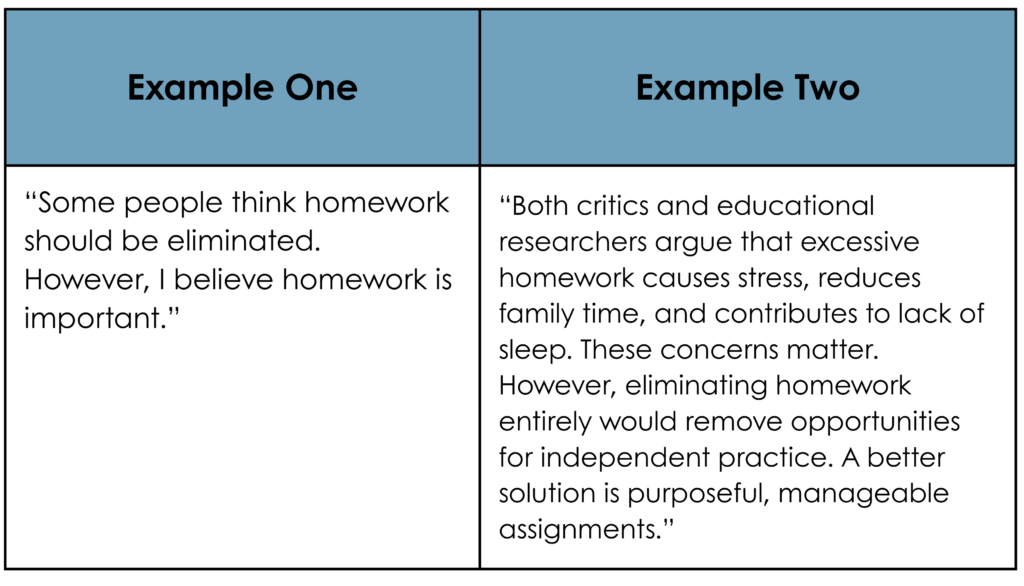
Example One engages minimally with the counterclaim. Example Two demonstrates much stronger engagement. It shows an understanding of the reasoning behind the opposing viewpoint, recognizes its validity, and responds with a thoughtful, more comprehensive solution.
Understanding the Power of the Opposing Argument
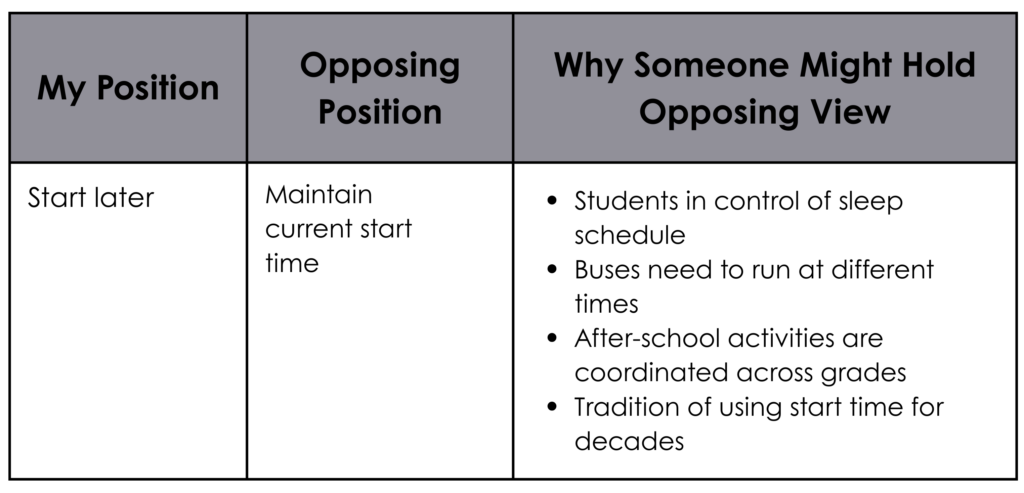
A key skill for argumentative writing is learning to identify and respond to the strongest version of an opposing argument. Let’s break down the viewpoints below for an argumentative essay about moving the start time of the school day in high school later.
Viewpoint One: High schools should move their start and end times later in the day.
Viewpoint Two: High schools should maintain their current schedule, with a 7:30 or 8:00 a.m. start time.
When considering arguments in favor of moving the start of the school day later, teachers can model engaging deeply with the opposing viewpoint using a think aloud and board notes.
Think Aloud
“If I argue that high school should start later in order for teens to get more sleep, someone might say students should just go to bed earlier. But that ignores research on teen sleep cycles. A strong counterargument would include the research on sleep as well as additional considerations like bus schedules, after-school activities, and parents’ work hours. Those are the counterarguments that I will need to address in order to make my claim.”
Board Notes
Organizing Claims and Counterclaims
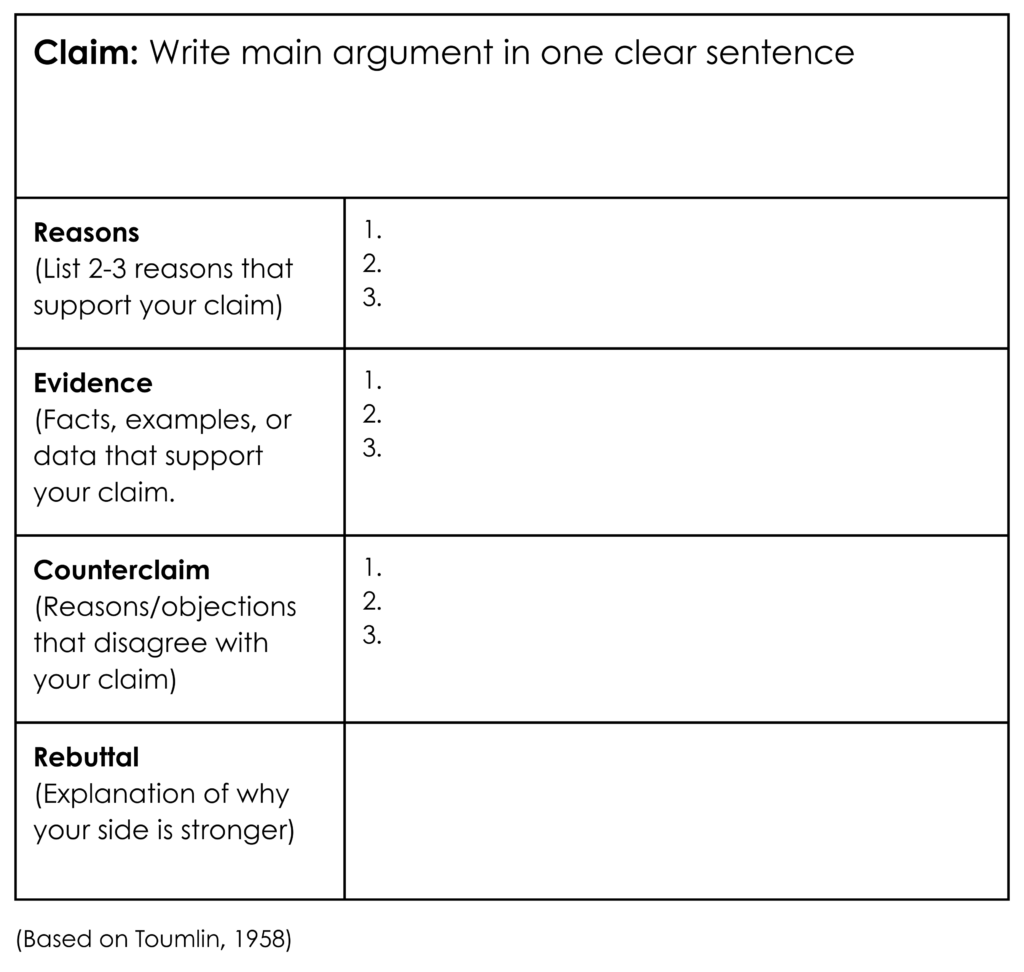
Simple graphic organizers can be used to structure a clear, comprehensive argumentative essay. While there are many variations, the one below ensures that all necessary components are addressed.
Embedding Counterclaims in the Writing Process
Counterclaim instruction is most effective when integrated throughout the writing process:
- Prewriting: After reading multiple reliable sources, students use graphic organizers to brainstorm possible objections to their claims before drafting their arguments. Discussions and mini debates can help surface diverse perspectives.
- Drafting: Provide sentence stems, frameworks, and models that encourage unbiased, well-developed counterclaims.
- Revision: Dedicate intentional instructional time for counterclaim paragraphs.
Ask:
- Have you addressed the strongest opposing argument?
- Have you acknowledged what makes it reasonable?
- Have you explained clearly why your position still holds?
Learning to engage with opposing ideas helps students develop empathy for diverse perspectives while engaging critically with multiple viewpoints. It also helps them produce powerful arguments substantiated with strong claims and real-world evidence.
References
Ferretti, R. P., & Graham, S. (2019). Argumentative writing: Theory, assessment, and instruction, 32, 1345- 1357, https://doi.org/s11145-019-09950-x.
Hillocks, Jr., G. (2011). Teaching argument writing: Supporting claims with relevant evidence and clear reasoning. Heinemann.
National Governors Association Center for Best Practices & Council of Chief State School Officers. (2010). Common Core State Standards for English language arts and literacy in history/social studies, science, and technical subjects. Washington, DC: Authors.
Nippold, M.A., & Ward-Lonergan, J.M. (2010). Argumentative writing in pre-adolescents: The role of verbal reasoning, Child Language Teaching and Therapy, 26(3), 238- 248, https://doi.org/10.1177/0265659009349979.
Toulmin, S.E. (1958). The Uses of Argument. Cambridge University Press.