








Argumentative writing sits at the heart of the Common Core State Standards (CCSS), especially as students move into the middle and upper grades. Although students often demonstrate the ability to debate in conversation, translating this skill into writing remains a persistent challenge. National data underscores this gap: According to NAEP findings, “only 25% of students’ argumentative essays provide strong reasons and supporting examples, and many fail to consider alternative perspectives” (Ferretti & Graham, 2019, p 1346). This raises an important instructional need for educators to assist students’ growth in conversational arguments while supporting their ability to formulate structured, evidence-based written arguments (Lewis et al., 2014). Even though the expectations for argumentative writing increase in complexity grade by grade, the CCSS anchor standards stay consistent through a student’s academic life. To support students effectively, it helps to outline the CCSS components of strong argumentative writing.
Expectations for Argumentative Writing
- Introduce Claims
- Present a clear statement that reflects one side of an argument
- Acknowledge opposing claims
- Use strong, direct, and precise language
- Highlight both strengths and limitations of the claim for the audience
- Logical Organization
- Reasons and evidence follow a logical progression
- Opposing claims are acknowledged and addressed
- Transitions clarify relationships among ideas
- Provide Reasons and Evidence
- Provide logical reasoning
- Select credible evidence that directly supports the claim
- Pull directly from texts, sources, and data
- Integrate quotes, statistics, and documented facts
- Clarify why the evidence matters
- Maintain a Formal Style and Objective Tone
- Maintain a formal style using academic language
- Use an objective tone appropriate for academic argument
- Start with an introduction, follow it with an argument that supports the claim for the duration of the essay, and end with a conclusion
Why Frameworks Help
Expectations can feel overwhelming for students who are still developing reading comprehension, analytical skills, academic vocabulary, and foundational writing competencies. That’s why explicit structures matter.
Scaffolds and frameworks give students predictable paths to follow. One of the most widely used structures, particularly in science and social studies classrooms, is the CER model: Claim, Evidence, Reasoning. This structure helps students focus on one clear idea at a time, supports their thinking with concrete evidence, and develops discipline-specific writing habits that strengthen their overall argumentative skills.
CER in Action: Classroom Examples in Content Areas
The CER framework can be utilized in argumentative writing across content areas. For example, it might be used to analyze the veracity of a hypothesis in science or the implications and significance of primary source documents in social studies.
Science Example: Plant Growth
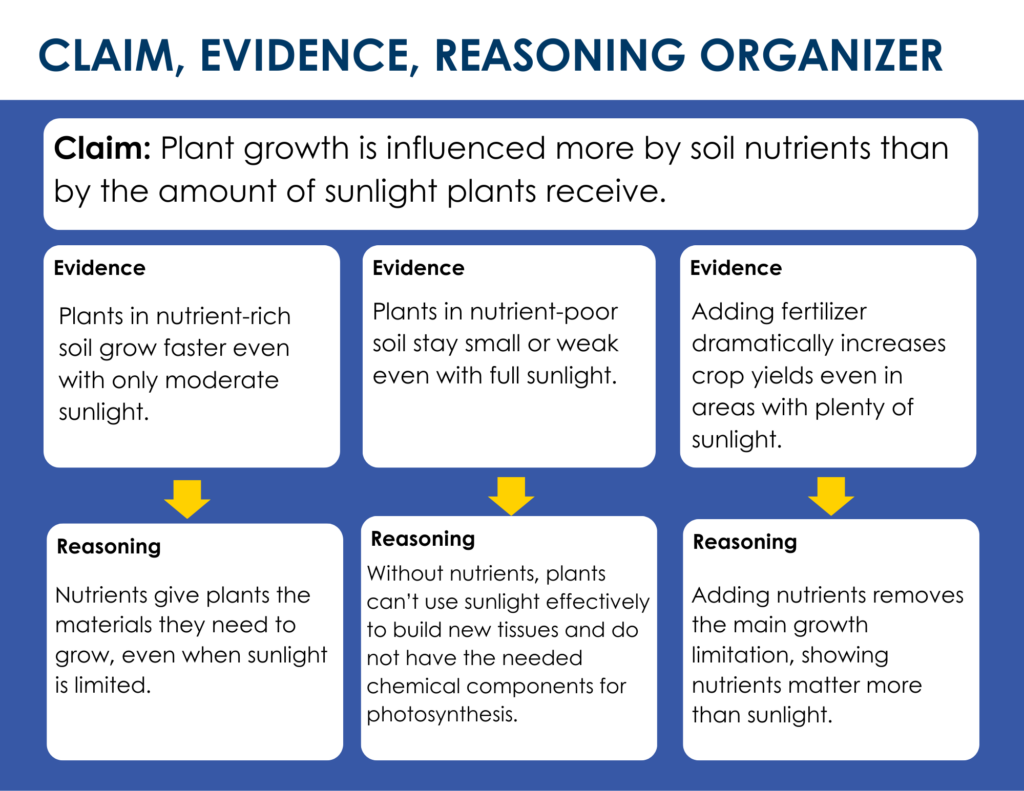
Here, the class worked together to build a graphic organizer about plant growth, creating and comparing different experiments with sunlight and soil conditions, supported by evidence from their experiment and scientific articles.
Claim-evidence-reasoning graphic organizers such as this provide the foundation for class discussion and a variety of writing assignments, including short responses, paragraphs, and essays.
Social Studies Example: Colonial Independence
Similarly, a CER graphic organizer could be used to support claims that economic self-interest motivated colonial resistance more strongly than political principles at the onset of the American Revolution. For evidence, students would utilize class texts and cull information from primary sources to help develop their argument.
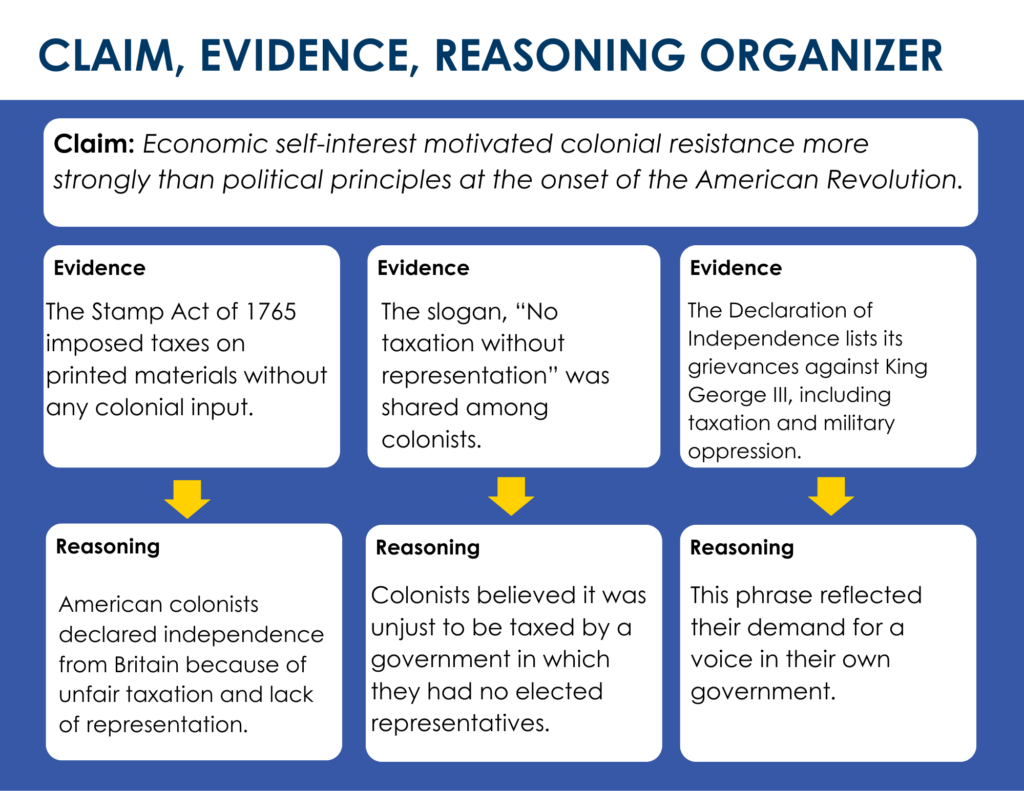
Once students learn to structure a basic argument, they can focus on expressing their ideas with academic precision. Teachers often expand this framework to claim → reasons → evidence → counterclaim → conclusion. The expanded framework can lend itself to creating outlines and structuring an essay starting with an introduction that includes a strong claim within the thesis statement; body paragraphs that include the evidence, reasoning, and counterclaims; and a conclusion which supports the overall argument.
Include Language Templates
The quality of students’ language directly strengthens their arguments. The framework of “They say, I say” (Graff & Birkenstein, 2024), highlights the conversational nature of argumentative writing. The heart of argumentative writing is listening to what has been said and summarizing statements in order to set up and respond with one’s own argument. For example, a statement such as “Homework is bad and teachers should assign less” would be much improved by using the “They say, I say” templates. Instead, students can respond to the statement with the claim “Instead of giving less homework, teachers should focus on assigning work that helps students understand the material more clearly.”
Since developing writers need to practice summarizing information to strengthen arguments, using templates, word banks and sentence/discussion starters like “Many critics assume … “or “Supporters contend….” provide scaffolds and pathways for all writers trying to support strong claims. Students also need exposure to the specific academic and disciplinary vocabulary used in formal argumentative writing.
Sample Noun and Verb Scaffolds for Argumentative Writing
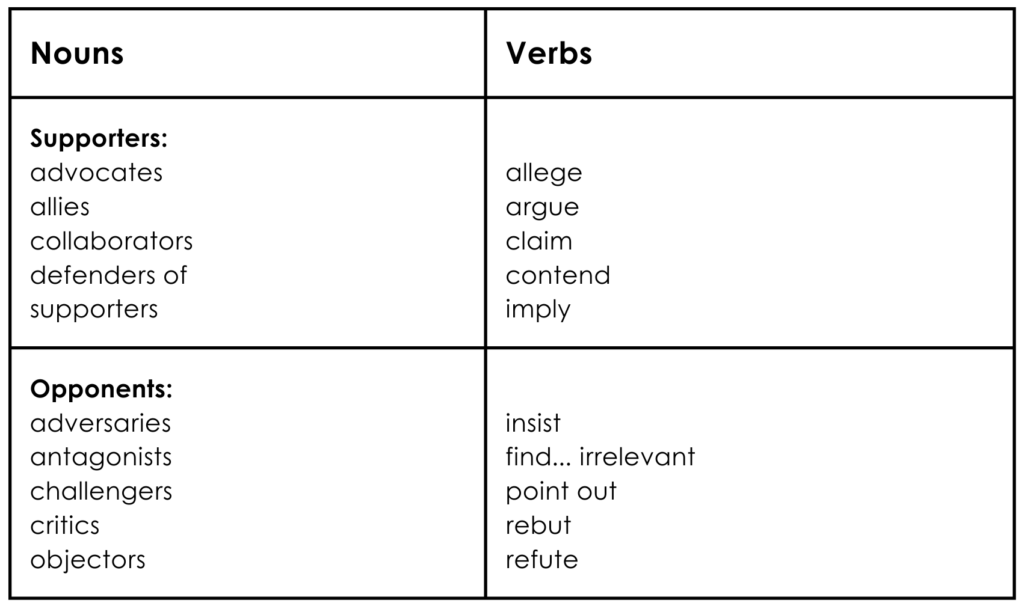
The above resource helps students develop academic vocabulary for debates and arguments both in oral conversations and in writing. In addition, students begin to better comprehend the terms when they encounter them in reading. Frameworks such as this and “They say, I say” (Graff & Birkenstein, 2024) also encourage fluency in sentence construction.
Even if students are able to verbally defend a position, writing demands a far more complex set of cognitive skills. To craft an effective argument, students must pull evidence from the text, analyze sources, synthesize information, connect ideas logically, remain objective, and provide clarity while summarizing in their own words. These tasks require extensive and explicit modeling, guided practice, and strong scaffolds. When educators provide direct instruction and practice with frameworks like CER, “They Say, I say,” and nouns and verbs for argumentative essays, they provide students the supports to successfully analyze texts and participate in structured debates during discussions and in writing. Modeling and practice build the foundation students need to reach the expectations of the CCSS and produce coherent, evidence-based arguments. When educators teach students how to develop arguments with clear criteria, they’re not just improving students’ writing—they’re strengthening students’ thinking.
References
Ferretti, R. P., & Graham, S. (2019). Argumentative writing: Theory, assessment, and instruction, Reading and Writing, 32, 1345- 1357, https://doi.org/10.1007/s11145-019-09950-x.
Graff, G., & Birkenstein, C. (2018). They Say, I say (4th Ed.). WW Norton & Co.
Lewis, W.E., Walpole, S., & McKenna, M.C. (2014). Cracking the common core: Choosing and using texts in grades 6-12, The Guilford Press.
National Governors Association Center for Best Practices, Council of Chief State School Officers. (2010). Common Core State Standards. Washington, DC: Author.